Harness-Agnostic Agent Infrastructure for Engineering Teams
Teams need infrastructure beneath their coding agents, not tied to any single tool.
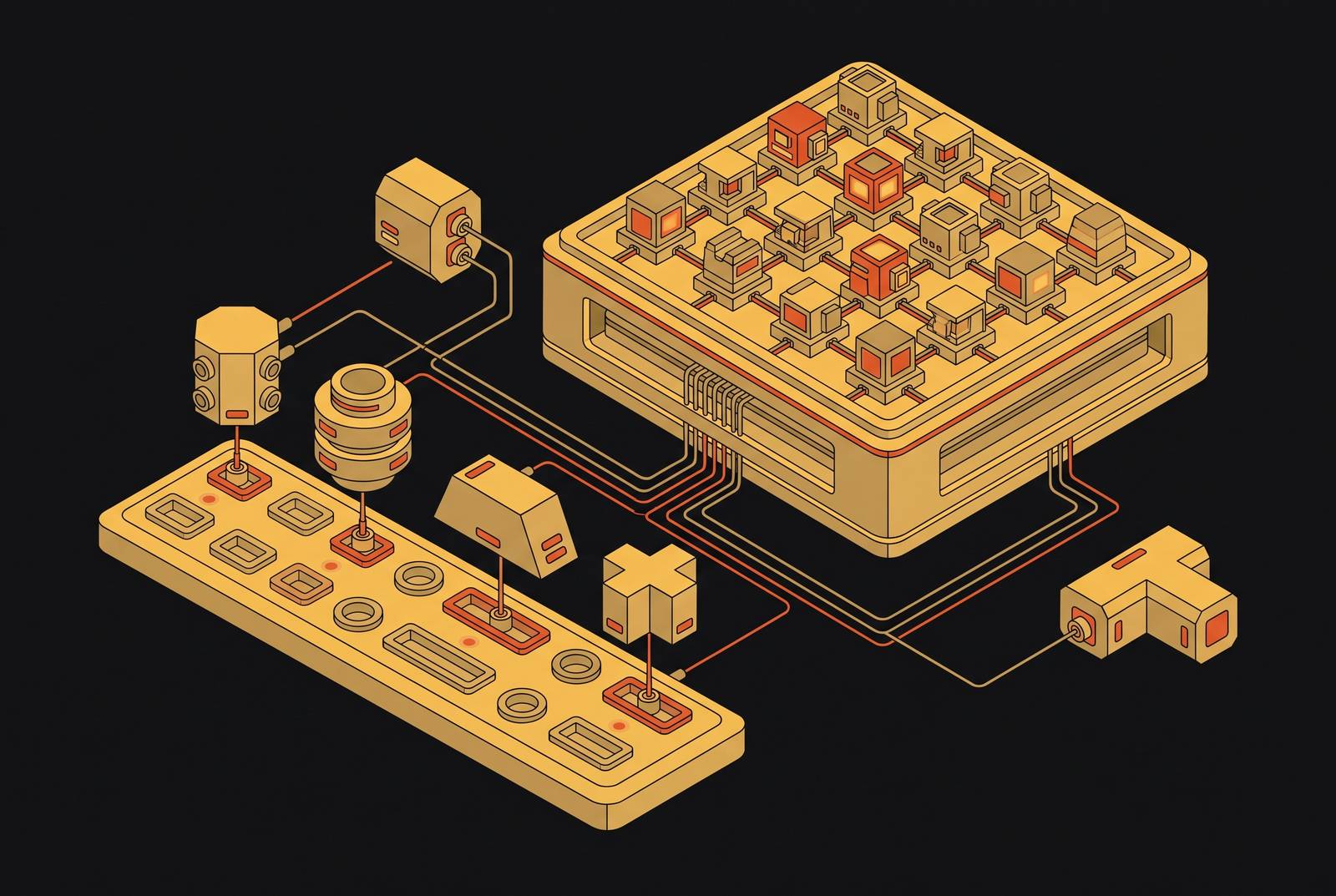
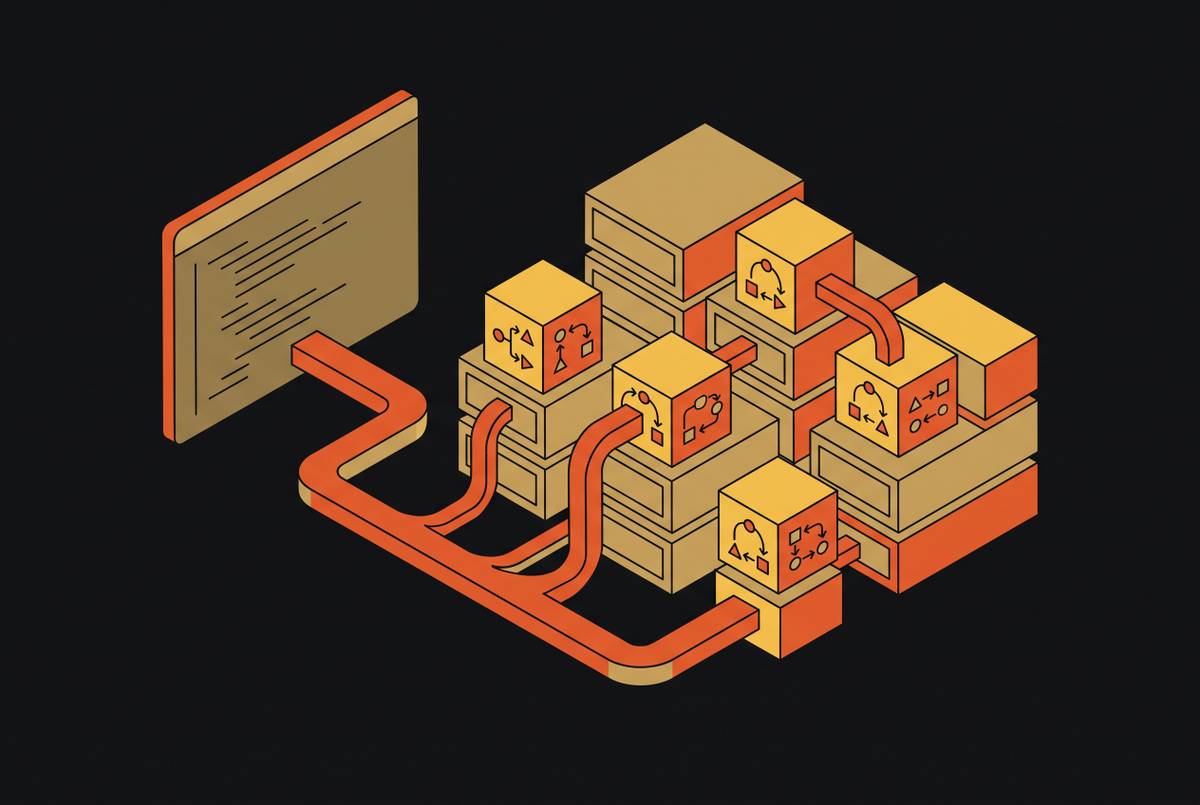
A multi-harness cloud coding agent platform needs a stable infrastructure layer beneath Claude Code, Codex, Cursor, or Opencode, so teams can swap or combine harnesses without rebuilding their setup. That layer provides isolated execution, shared context, consistent permissions, workflow integrations, and attribution. It also lets engineers trigger Claude Code or Codex from Slack and receive a pull request through harness-independent routing.
Why the harness layer, not the model, now determines agent reliability
In 2026, model selection has become a configuration choice, while reliable engineering output from reasoning depends on tool orchestration, context management, verification loops, permission boundaries, and sandbox configuration. The shift from prompt engineering through context engineering to harness engineering shows how much more the work now covers. A good prompt cannot supply an execution boundary. Nor can it keep repository instructions up to date or set which credentials an agent may use.
The formula Agent = Model + Harness makes the division clear. The model supplies reasoning, while the harness connects that reasoning to tools and constrains its execution. Reliability therefore depends on both the model’s ability to propose a correct change and the system around it. A production agent must also operate within permissions, verify its work, and produce output that can be attributed.
Galster et al.’s Harness Engineering for Agentic AI Coding Tools: An Exploratory Study systematically analyzes configuration across Claude Code, GitHub Copilot, Cursor, Gemini, and Codex. The study identifies eight mechanisms, namely Context Files, Skills, Subagents, Commands, Rules, Settings, Hooks, and MCP servers. These mechanisms span static instructions, executable behavior, and external integrations. Choosing a harness consequently means choosing how those controls fit together, which makes lock-in an infrastructure question.
Why no single harness dominates, and what that means for teams building on top of them
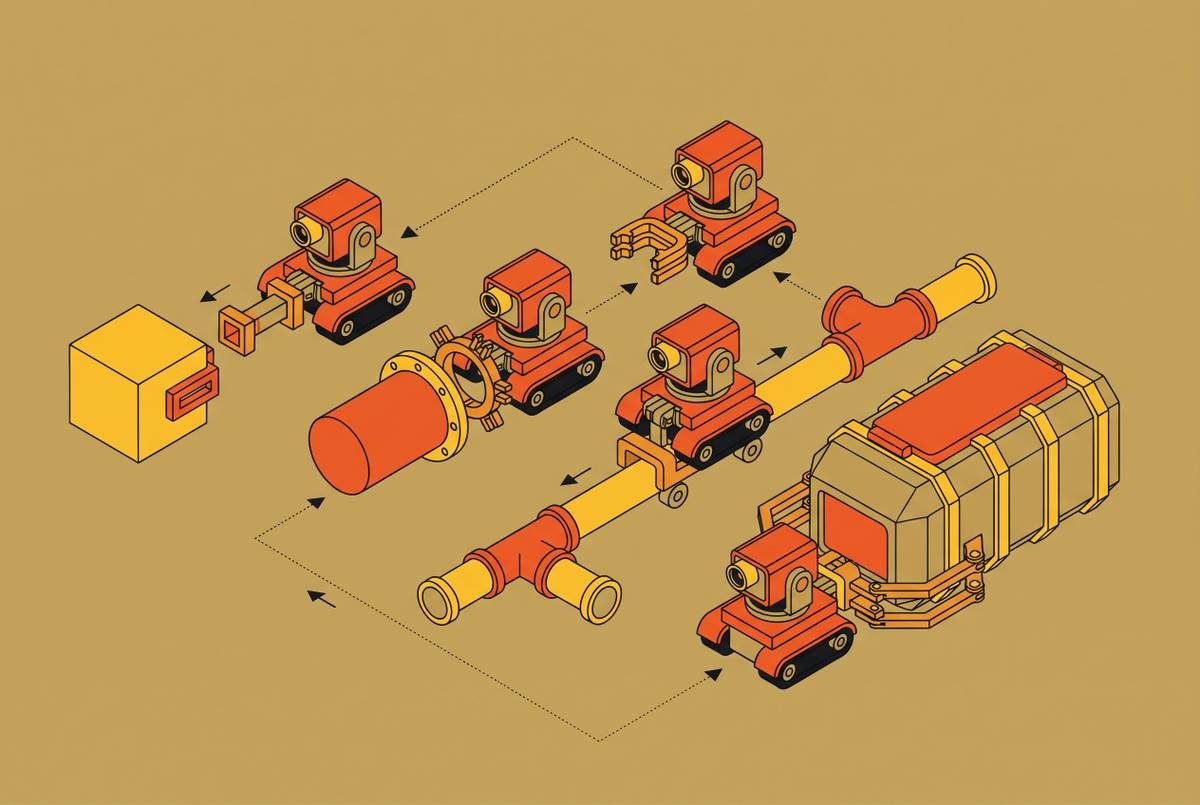
Harnesses occupy different parts of the engineering workflow. Cursor’s IDE-first approach lets agents work inside real-time editing, while terminal-first tools such as Claude Code and Codex let them carry out long-horizon execution and reason across the codebase. Cloud-delegated harnesses serve another operational model, running asynchronous work in sandboxed VMs while the engineer works elsewhere.
Professional teams can therefore use an IDE for collaboration, a CLI for local execution, and cloud agents for asynchronous delegation. One harness need not serve every layer. Teams can choose a harness to suit each layer and task, and that choice can change as models and harnesses develop. Fragmentation is a condition for teams to architect around now.
The cost of changing tools depends on where configuration lives. A team that binds its context, permissions, and integrations to proprietary harness conventions faces a rebuild when changing tools. The study finds that Context Files dominate configuration and are often the sole mechanism configured in a repository. Those files may be portable as artifacts while remaining tightly coupled to one tool’s conventions. An infrastructure layer beneath the harness must separate these durable team assets from the configuration needed to expose them to a particular agent.
What harness-agnostic infrastructure actually means — the five components a team must own
Five components form the stable layer beneath a rotating harness layer. They are sandboxed execution environments, normalized context delivery, unified permissions and authorization, workflow integrations, and observability with attribution. Together, they define where an agent works, what it knows, what it may do, how work reaches it, and how its results are assessed. Ownership sits below the individual tool’s configuration.
The execution environment supplies isolated workspaces pre-loaded with the team’s dependencies and tooling, with secrets scoped to the run. This gives each harness the same working baseline without letting one run affect another workspace or production. Normalized context gives each harness canonical instructions and architectural constraints in a form it can read. The environment establishes operating conditions, while context establishes engineering expectations.
Permissions constrain action across both of those components. A policy gateway checks requested tool calls against a per-team allowlist before forwarding them to an MCP server, so repository access, secrets access, and permitted actions do not depend solely on the calling harness. MCP gives tools a shared access layer where the same authorization checks can be applied.
Workflow integrations connect this controlled execution path to the team’s existing work surfaces. Observability then attributes the resulting output independently of the harness’s own reporting. These components work as an architecture because each preserves a team-level contract while the harness changes. With that layer in place, teams can choose a harness through configuration without tying their infrastructure to it.
Sandboxed environments in practice — what isolation must enforce and how to configure it
Sandbox isolation must prevent one agent’s actions from contaminating another workspace or reaching production systems. The boundary includes more than application files. Network egress allowlists should restrict agents to explicitly approved endpoints, while workspace write restrictions must cover dotfiles and auto-executing configuration directories. Hooks, MCP server configurations, and IDE extensions must remain protected from agent modification regardless of user approval level, because changed configuration can propagate behavior into subsequent runs.
A request travels from the agent runtime through a policy gateway for an allowlist check, then to an MCP server and an isolated executor. Controlled network egress constrains external access, and sanitized structured output returns to the model. Each layer is independently auditable and replaceable without changing the harness.
A sandbox-based declarative model moves capability requirements into the tool’s interface definition. The platform enforces that boundary rather than requiring separate firewall rules, seccomp profiles, or network policies for every harness. This reduces the configuration surface that teams can get wrong when adding another tool. The study places sandbox configuration within Settings, one of the eight mechanisms.
Provisioning policy also affects the cost of isolation. An on-demand sandbox starts when an agent needs to execute code, rather than enclosing the full session in a running sandbox. This reduces idle infrastructure cost, particularly for long-running or multi-harness workloads. Security still requires isolated execution, while provisioning sets when the capacity to run code is available.
Context delivery across harnesses — maintaining a canonical layer that any agent can read
Teams that have spent months tuning AGENTS.md files to one harness can feel unable to switch. Their institutional knowledge has become entangled with a tool’s conventions. A canonical context layer resolves that friction by maintaining one set of engineering instructions and exposing or translating it for whichever harness is active. It replaces parallel sources of truth with a shared reference.
That shared reference must cover more than a top-level instruction file. Architectural constraints include module boundaries, dependency rules, and naming conventions, while Plan.md, Implement.md, and Documentation.md provide reusable task decomposition artifacts. Skills and subagent definitions encode specialized work such as test generation, migration, and documentation sync. The study treats Skills and Subagents as distinct mechanisms, so portability must address their definitions as well as Context Files.
A shared reference still needs active maintenance. As the codebase changes, instructions can describe boundaries or conventions that no longer match the code. Periodic refresh agents at the infrastructure layer should detect and repair that drift, independently of the harness chosen for implementation work. Otherwise, every harness inherits the same stale assumptions.
Mitchell Hashimoto’s founding principle for harness engineering is that each agent mistake should become a permanent fix that prevents the error class from recurring. Applied to context, a failure caused by missing or stale instructions calls for a canonical update. The resulting layer is also a knowledge asset, preserving engineering conventions beyond the lifetime of any individual harness.
How can engineers trigger Claude Code or Codex from Slack and get back a pull request?
The infrastructure layer should receive the Slack trigger, select Claude Code or Codex through configurable routing rules, and pass the task to the selected harness’s execution environment. It then returns a pull request link or status reply to the originating surface. The harness does not need Slack-specific trigger configuration.
A Linear label or GitHub issue can initiate a run without naming a harness, because routing can depend on task type, available harness, or team configuration. GitHub and GitLab integrations should use the same infrastructure-owned approach to triggers and outputs.
Structured output also supports coordination across runs. A daily digest can combine open pull requests, blocked items, and pending reviews from multiple harnesses rather than relying on one harness’s reporting format. This is the practical value of decoupling. Slack workflows, Linear automations, and GitHub webhook configurations no longer have to be rebuilt around each tool’s conventions.
Each integration-layer agent action should be tied to a specific authorized user and run under that user’s permissions. A harness swap must not create a gap between who requested the work and what the agent can access.
Observability and attribution across harnesses — measuring what agents actually ship
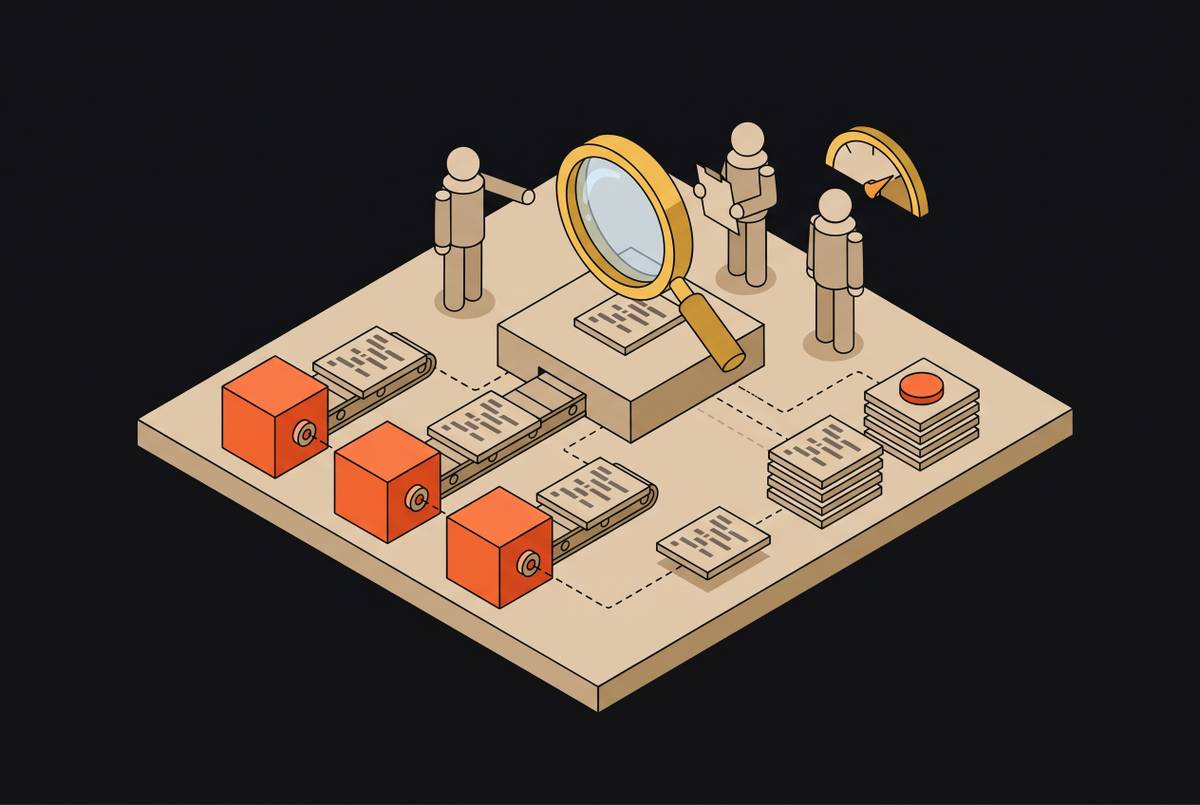
Infrastructure-level attribution makes comparisons between harnesses operationally useful. Without it, teams cannot establish which harness performs best on a task class, which model consumes cost without proportionate output, or whether a switch improved results. Harness-local logs do not provide the independent reporting boundary this comparison requires. The unit of attribution is the individual run.
Each run should record its task source, including Slack, Linear, GitHub, GitLab, or a dashboard. It must also identify the harness, model, and credential of the authorized user or service account. Execution time and resource consumption describe the work spent, while the output records whether the run produced a pull request, recording, reply, or failure. These fields link what the work cost to what it produced.
That connection enables cost per completed task to be computed. Two harnesses using the same model on similar tasks can use very different amounts of tokens, so teams need more than model choice to compare costs. Cross-harness attribution makes those metrics available beyond one tool’s reporting.
Attribution also directs corrective work toward the relevant configuration. A failure linked to a harness, model, and context configuration can lead to a targeted fix rather than an undifferentiated judgment that the agent failed. Full attribution transforms a collection of runs into a managed engineering capability.
How to architect harness-agnostic infrastructure in practice — a phased approach for engineering teams
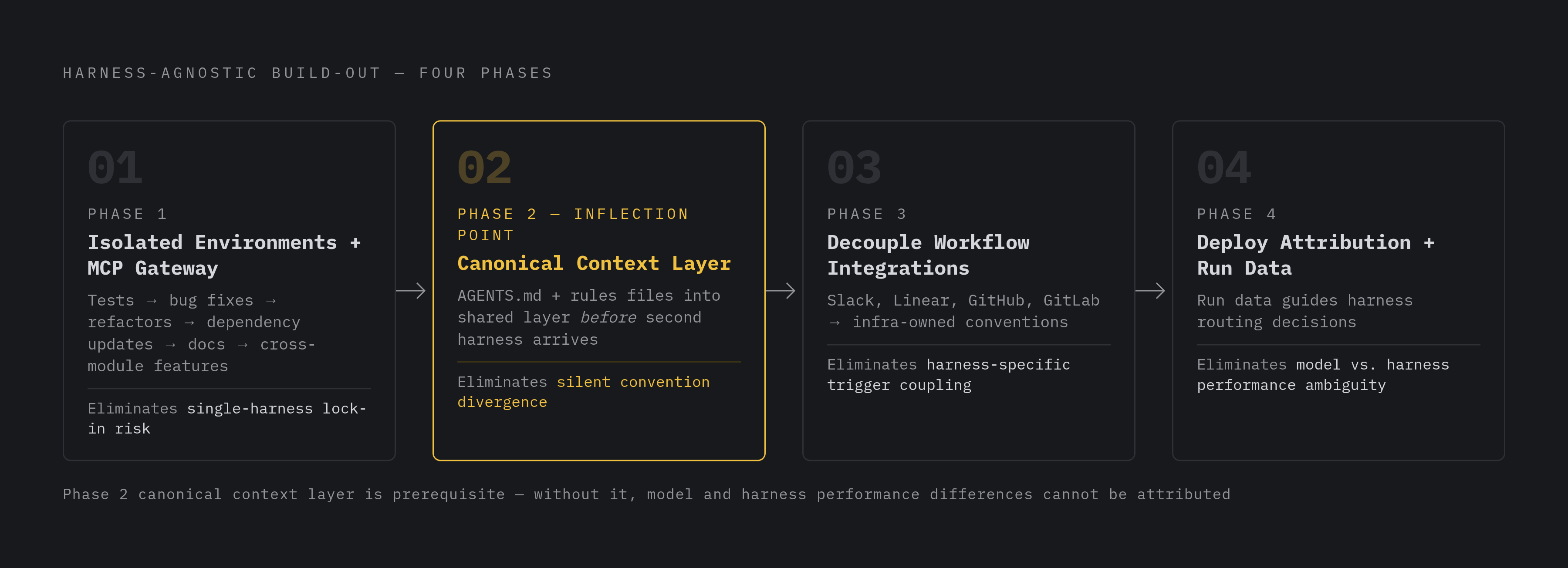
Engineering teams should build the architecture in phases, first putting in controls that prevent lock-in and unsafe execution, then adding optimization. The first phase establishes isolated environments and a cross-harness MCP policy gateway before a second or third harness is introduced. Task scope should expand gradually, starting with tests and small bug fixes, then low-risk refactors, dependency updates and documentation sync, and finally cross-module feature work. Sandbox controls bound what each stage can reach.
The second phase establishes canonical context before onboarding the second harness. The AGENTS.md and rules files already used for each harness should move into a shared layer that both tools can read. This prevents separate conventions from developing silently. Without that step, differences in agent behavior can be attributed to the model when inconsistent instructions are the cause.
The third phase decouples workflow integrations before harness coverage expands to more engineers or teams. Slack, Linear, GitHub, and GitLab triggers and outputs should move to infrastructure-owned conventions. Engineers can then retain their existing delegation surfaces while routing changes underneath them.
The fourth phase deploys attribution and uses the resulting data to guide routing. Once multiple harnesses run through the same layer, teams can compare task-class outcomes, identify underperforming configurations, and make selection data-informed. Every infrastructure component should reduce the cost of replacing the harness above it, rather than turn support for several harnesses into several separate infrastructure commitments.