Evaluating Coding Agent Output Quality in Team Workflows
Review layers must connect agent output to tasks, validation evidence, and execution environments.
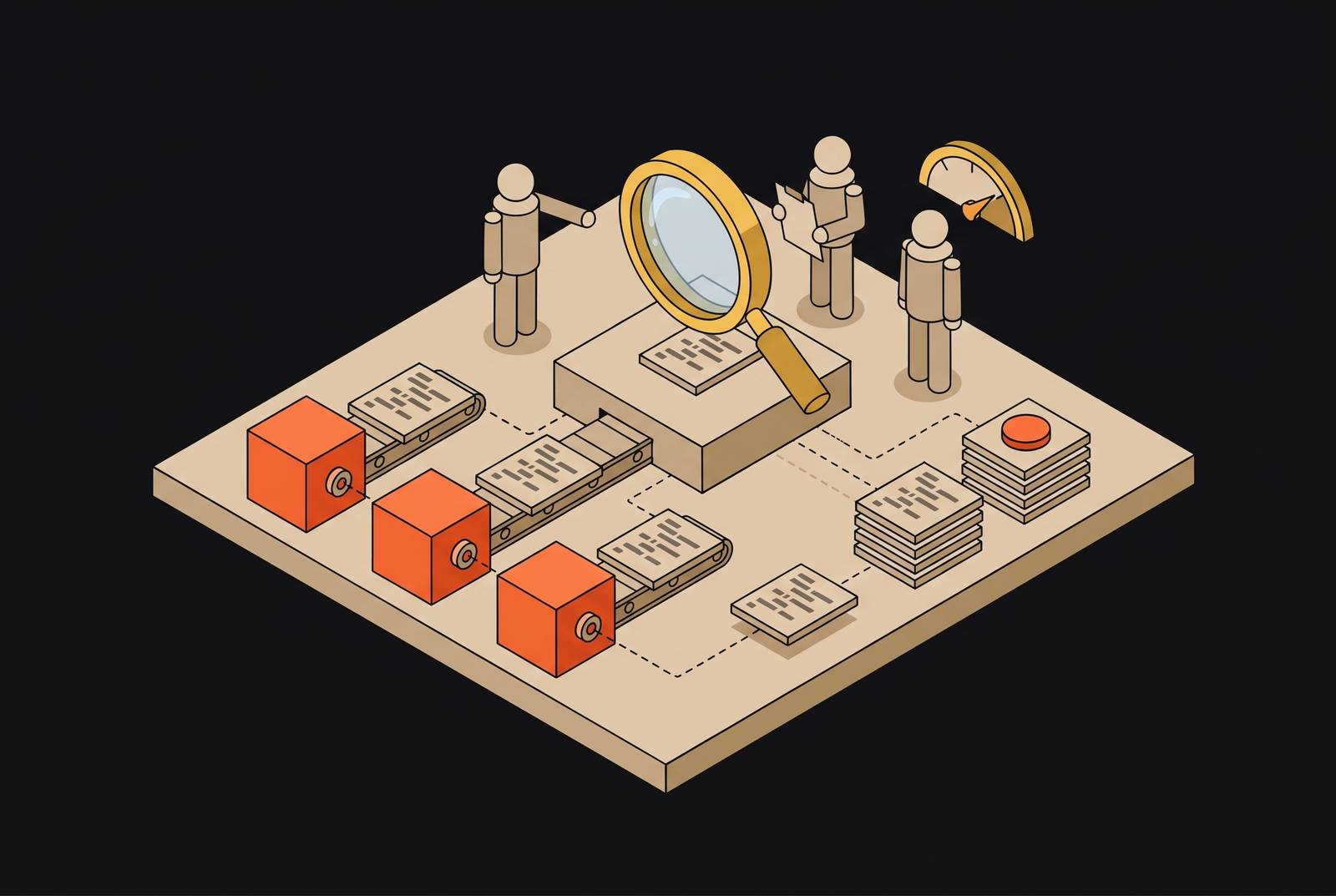
A multi-harness cloud coding agent platform lets teams run different coding agents in parallel on shared cloud infrastructure, but how useful it is depends on how well teams can review the work. The decisive capability is a review layer that connects each change to its task, validation evidence, execution environment, and authorizing credentials.
Why output volume is the wrong proxy for agent quality
More pull requests can mean longer queues and less confidence, even when more changes reach the codebase. Delegated agents accept tasks, plan, execute, validate, and open pull requests, shifting engineers’ work from guiding execution to assessing finished output. Generation is no longer the limiting step. The constraint shifts to whether reviewers can distinguish a sound implementation from a plausible one before the next batch arrives.
Merged PR count cannot make that distinction. A dependency bump, a test cleanup, and a core refactor each count as one merged PR, though each needs a different level of review. Microsoft’s CLI agent rollout study uses merged PR count as its sole output proxy and acknowledges that it is only a proxy for quality. That limitation calls for a separate review layer, rather than treating the agent’s completed self-check as sufficient evidence for merge.
How delegated agents change what "review" needs to cover
A delegated agent’s validation becomes an input to human review. Its loop includes context gathering, planning, code generation and execution, self-validation, and delivery, so tests may already have passed before the reviewer sees the change. Passing tests leave an important gap, however. They can catch syntax errors and tested failures without detecting intent drift, where the implementation solves a subtly different problem from the one assigned.
That gap changes what reviewers must reconstruct. A human author can explain a design choice from the reasoning behind it, while an agent-authored PR leaves the reviewer dependent on its written account and tooling logs. High-level tasks spanning a codebase make this harder because the reasoning must be recovered from a large diff. When a designer or product manager delegates the task, the engineer may also lack a human author who can answer implementation questions. The review layer therefore has to establish intent fidelity, execution quality, and provenance rather than assume those foundations are already present.
Signals that actually distinguish trustworthy agent output from plausible-looking output
Intent fidelity asks whether the diff is explainable entirely by the assigned issue. A linked Linear issue or GitHub issue gives that judgment a concrete reference. Unrequested reformatting and adjacent refactors are warning signs. Even when those changes look reasonable individually, they expand the task boundary and make the original request harder to assess. A reviewer needs to distinguish changes required by the issue from changes the agent merely decided to make.
New tests can satisfy a CI gate while failing to exercise the behavior that changed, so test presence alone offers weak reassurance. Coverage delta on changed lines is more informative than total coverage. Reviewers can also check whether the new tests fail when the implementation is reverted, using mutation testing logic to check the claimed fix. This separates evidence of changed behavior from tests that pass without depending on it.
Diff proportionality compares the change with the task’s complexity. A large diff for a simple request can indicate over-engineering, scope drift, or speculative code the agent could not validate. Small is not automatically better, either. A tiny implementation of a complex requirement may bypass necessary handling. Proportionality is a reason to investigate.
An agent that states its interpretation of an ambiguous requirement exposes a point where human judgment is needed. Silence may reflect a precise task, or it may conceal an assumption that shaped the entire implementation. Stable project instructions can reduce ambiguity, but explicit assumptions still help reviewers locate the parts of a change that deserve attention.
Provenance completeness asks whether the output can be traced to its run, agent, harness, model, and credentials. Without that record, a successful PR does not explain which conditions produced it, and a failure is difficult to diagnose. Attribution also connects quality to token spend. That link helps teams tell which tasks yield useful work at a low cost and which use up a lot of resources and still need major repairs.
Where the signals break down and why context engineering partially repairs them
These signals are downstream of the agent’s setup. Intent fidelity is hard to judge when the task has no clear boundary, and test quality is harder to judge when no one has said how the code should behave. Context engineering makes the signals more readable by defining authorized changes, stable project rules, reusable domain knowledge, and explicit standards for a passing PR.
In practice, AGENTS.md, CLAUDE.md, or equivalent files can hold coding conventions, dependency constraints, and patterns to follow or avoid. A glossary gives the agent the system concepts needed to interpret the codebase, while task instructions establish what it must leave untouched. This preparation has a real cost. The reusable portion, however, serves later runs instead of forcing each reviewer to correct the same misunderstandings. Teams still need to set the boundaries of each task they delegate.
A well-specified task can still produce untraceable output if the tooling does not log the run. Nor can written instructions replace an environment in which the agent can install packages, inspect dependencies, and execute tests. These are limits on what preparation can accomplish. They lead directly to infrastructure as a condition of reviewable output.
Why the execution environment shapes output quality as much as the model does
An agent needs real compute to validate its work. Installing packages, running build scripts, executing tests, and reading error output are required parts of the task. If the environment blocks those steps, the reviewer has to do the validation. That transfer undermines delegation because the engineer must finish the work that the agent’s delivery appeared to include.
Isolation makes validation results easier to trust. When concurrent sessions share a filesystem or dependency cache, one session can contaminate the conditions under which another passes or fails. Per-session boundaries, scoped network access, resource limits, and audit logging make it easier to tell what happened during execution. An agent can still misuse legitimately granted access, so over-scoped credentials remain a problem inside a sandbox.
Ramp uses sandboxed environments for background coding agents that make commits or pull requests, so self-validation happens inside the execution boundary. Pre-loaded environments also cut down on failures from installing and testing against the wrong dependency version. Preparation improves speed as well as reliability. Cursor’s Builds feature, shipped August 13, starts cloud agents in a pre-configured environment, so each agent can use it without building one from scratch. Reviewers need to know whether validation took place in the intended environment.
Building the review layer that acts on these signals consistently across the team
To operationalize these signals, teams should attach the source task when the PR opens, sparing reviewers the need to reconstruct it during review. A Linear issue, GitHub issue, or Slack delegation thread gives all reviewers the same place to start. The PR template should then show the agent’s self-check. It should state what changed and why, what remained untouched, which assumptions shaped the work, what the tests cover, and what specifically needs human scrutiny.
The workflow also needs evidence beyond the individual PR. Review comments per PR and revert or hotfix rate are useful supplements to merged PR count beyond the metrics measured by Microsoft’s study. Comparisons should account for task scope. Consistently heavier review discussion on agent-authored changes can point to degraded context or weak evidence, while rising reverts can warn that context or environment configuration needs attention before delegation expands further.
Per-run attribution turns those warnings into diagnosable problems. Recording the agent, harness, model, and credentials allows teams to investigate whether failures cluster around a task type, execution environment, or particular configuration. Cost attribution adds another routing input. Teams should start with work that has clear boundaries, such as test repair, dependency upgrades, and lint fixes, and take on more only when reviewed PRs show that the output can be trusted. Microsoft’s rollout found that peer visibility helped spread first use, making repeatable, legible results especially valuable as adoption grows.
How does a multi-harness cloud coding agent platform affect output quality at the review layer?
Claude Code is terminal-first and built for deep autonomy on complex multi-file work, tending toward thorough, verbose output that takes longer to review. OpenAI Codex is multi-surface and included across existing ChatGPT subscriptions, supporting broader access that includes non-engineers. Broader delegation increases the importance of preserving task intent, while extensive autonomous changes increase the importance of readable evidence.
Cursor is editor-first, with its agent inside an AI-native VS Code fork, suiting developers who want to see and accept changes in context. Its Router feature, shipped July 22, routes requests to the most cost-effective model, with Teams/Enterprise controls over optimization modes and model availability. Opencode offers a different kind of flexibility. It is open-source under the MIT license, supports over 75 LLM providers, and allows models from different providers in the same agent team. Those differences affect where teams can exercise model choice and how they organize supervision.
The useful comparison is output quality by task type. Claude Code typically uses substantially more tokens than Codex on identical tasks, depending on the task, so thoroughness must be evaluated against token cost and review burden. Tool-use success, retry economics, and supervised pass-rate at first attempt are more directly relevant to reviewer workload. A cloud platform with multiple harnesses and per-run attribution lets teams use their own PR evidence to route complex work where the output is easy to review and routine work where the cost is predictable.
What a team-wide operating model for agent review actually looks like in practice
Ramp’s Inspect connects specifications, customer feedback, and code through Linear’s API, and its internal coding agent accounts for a large majority of merged PRs. Coinbase’s Forge uses Linear’s Agent SDK and operates across Slack, GitHub, and Linear with context already present in those systems. Both examples place context before execution. Their significance for review is that the task’s origin and supporting information do not have to be reconstructed after the code arrives.
Teams that want Slack-triggered Claude Code or Codex runs to return a pull request automatically need more than a chat integration. The entry point must preserve a traceable task origin, and the resulting PR must expose the evidence needed for review. Quality gates belong in the workflow itself. Intent fidelity, test quality, diff proportionality, uncertainty, and provenance should appear through PR templates and CI checks. The team then uses its review comment rate, revert rate, and cost-per-merged-PR to guide how it prepares context and routes work to a harness.
Managed cloud execution makes parallel delegation scalable when each run has its own isolated VM, pre-loaded dependencies, and full attribution to source, harness, model, and credential. The operating model should mature through bounded tasks and a corpus of reviewed PRs before moving into more complex delegation. The final test is practical and demanding. A reviewer should be able to reconstruct what the agent was asked to do, what it did, what it checked, and who authorized it from the PR alone. Any missing answer identifies a gap in the review layer, regardless of how much code the agent produced.