GitHub Issue to Pull Request Over Managed Agent Infrastructure Without a Single DevOps Touchpoint
Managed cloud agents can turn issues into PRs without DevOps work.
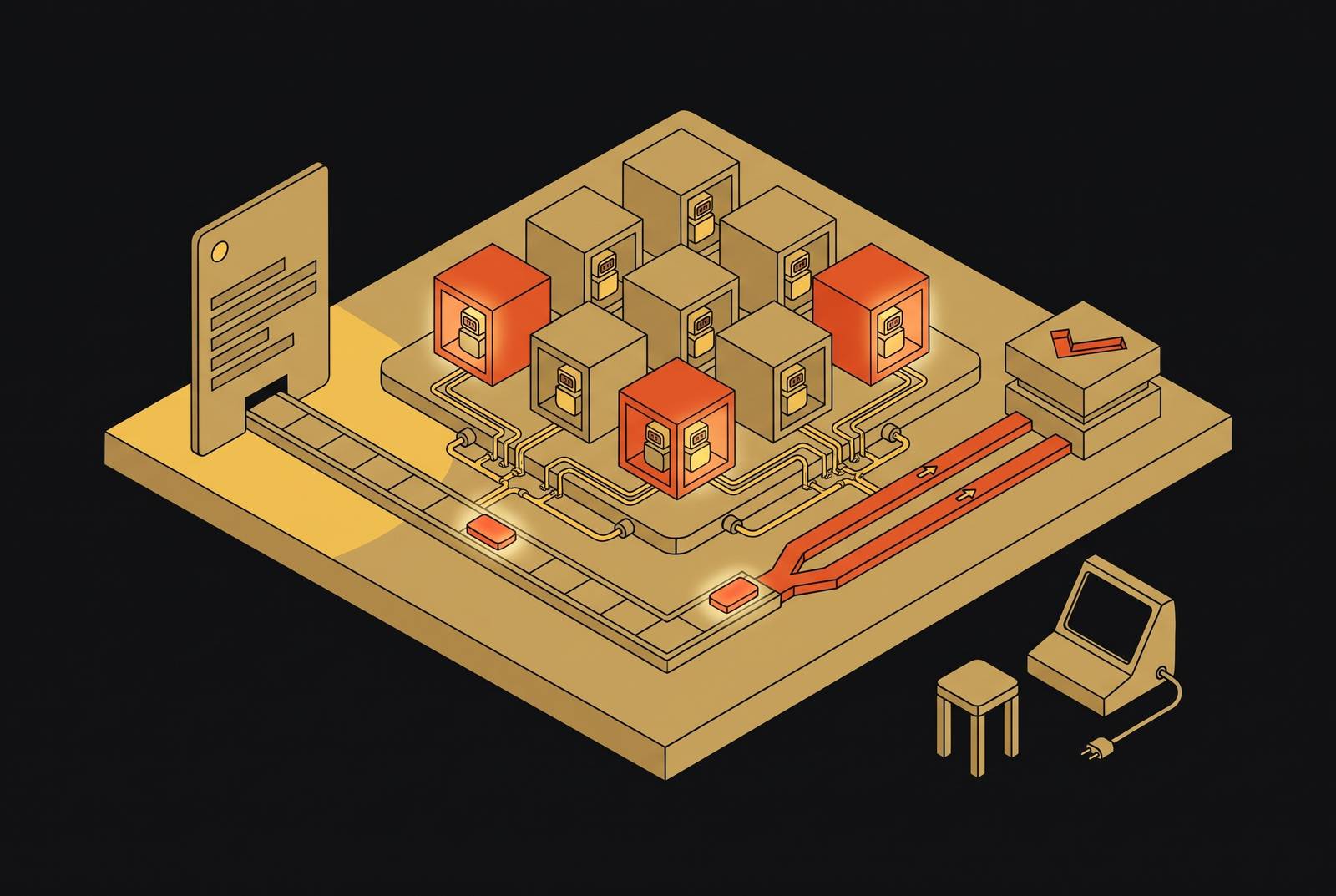
A bring-your-own API key cloud coding agent runner must do more than give Claude Code or Codex a place to run. For issue-to-PR work without DevOps intervention, the managed environment must handle repository access, task isolation, credentials, integrations, and policy enforcement. Using an Anthropic or OpenAI API key does not itself remove infrastructure work. The environment removes that overhead, while the pull request preserves human judgment at the merge decision.
Why the issue-to-PR path still carries hidden DevOps overhead when agents run locally
A local coding agent starts with the environment it receives. Before it can make a useful change, someone must clone the repository, install the right language runtime, configure environment variables, and make the test suite runnable. Agent capability does not resolve those dependencies. A stronger model may write better code, but the developer still has to make sure that code can be tested and delivered.
Someone must write or maintain GitHub Actions YAML, connect webhook triggers, and give the runner the permissions needed to push a branch. Those are infrastructure tasks. Moving the agent into a CI runner changes where it runs, but the same people may still have to maintain the path it runs through.
Credentials make this distinction more consequential than convenience alone. Microsoft's security research documented a case in which the Read tool accessed /proc/self/environ and read the workflow's API key. The sandbox covered subprocess execution but not file reads. The same research showed how issue or PR content that an attacker controls could steer an agent with access to secrets, file-reading tools, and external channels.
“Just run the agent” therefore displaces work. Without the missing setup, the agent may be unable to run tests or push branches, while an inadequately isolated environment can expose credentials. Zero DevOps must mean that the execution path meets these requirements without an operator stepping in for each task. It cannot mean that the requirements disappear.
How do you run Claude Code or Codex in the cloud without managing infrastructure?
A managed execution environment removes the team's responsibility for administering a remotely hosted shell. In this model, each task starts in a pre-configured, disposable VM with repository access, a toolchain, and credential handling already arranged. The developer selects a GitHub repository and describes the task. The environment performs the clone, so the repository need not exist on the developer's machine.
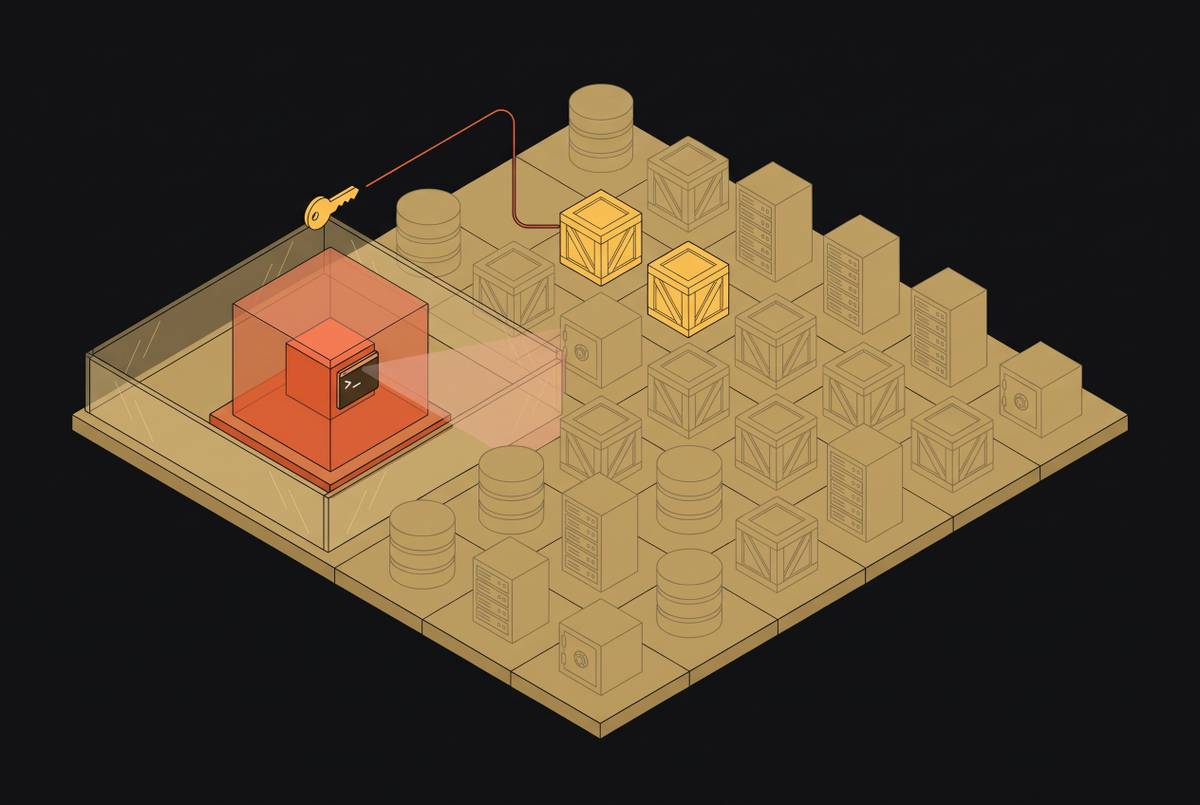
Claude Code's cloud session documentation describes “complete isolation” where “the virtual machine exists only for that specific task.” That task boundary separates the agent's working environment from other work. GitHub authentication runs through a secure proxy, which keeps credentials out of the environment where the agent works. This addresses the exposure mechanism that a local shell or CI runner can otherwise leave intact.
The managed session runs the setup commands declared by the repository, including dependency installation, database initialization, and migrations. Declarative setup is a way to make the required preparation part of the task lifecycle, incorporating what would otherwise be a separate activity performed by a developer.
Network access also belongs to the infrastructure layer, where an operator can control what the VM reaches. The agent must also have no say over secret scanning and policy gates. These are properties to establish when choosing and configuring the environment, including environments described as “cloud. Once that foundation is in place, the agent can push a new branch and open a PR without a human managing the intervening infrastructure.
How the issue-to-PR lifecycle flows when the infrastructure is pre-wired
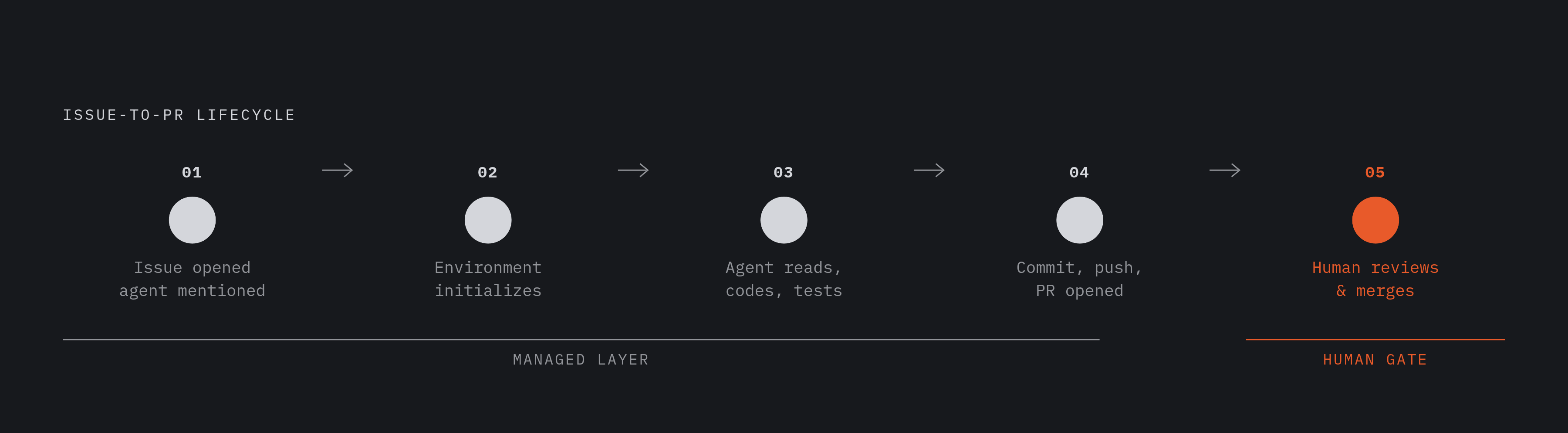
Claude Code's cloud session documentation starts with choosing a repository and creating a cloud session. The environment initializes from repository configuration before the agent reads the issue, writes code, and runs tests. The agent then commits, pushes a branch, and opens a PR. Each step has a place in the managed lifecycle rather than depending on a developer to connect it to the next one.
Trigger integration is a separate part of that path. The @claude mention pattern uses the Claude GitHub App, while /install-github-app generates the GitHub Actions workflows automatically. The team merges the generated workflow PR once. This removes hand-written YAML from that setup, but it remains distinct from having no onboarding or authorization work at all.
With the integrations established, a developer can open an issue, mention the agent, and leave the page while the task runs asynchronously. A Sentry production error can trigger an alert rule that creates a Linear issue through the Sentry–Linear integration. The agent can then begin root-cause analysis and fix generation from that issue.
The /ultraplan path illustrates a hand-off with an additional planning checkpoint. A terminal command starts cloud planning, after which the developer reviews and annotates the plan in the browser and clicks Accept. Execution then proceeds in the managed environment. It installs dependencies, writes code, runs tests, verifies a live endpoint, and opens a PR with a built-in test plan and a link to the session.
Running multiple agent tasks in parallel without multiplying infrastructure work
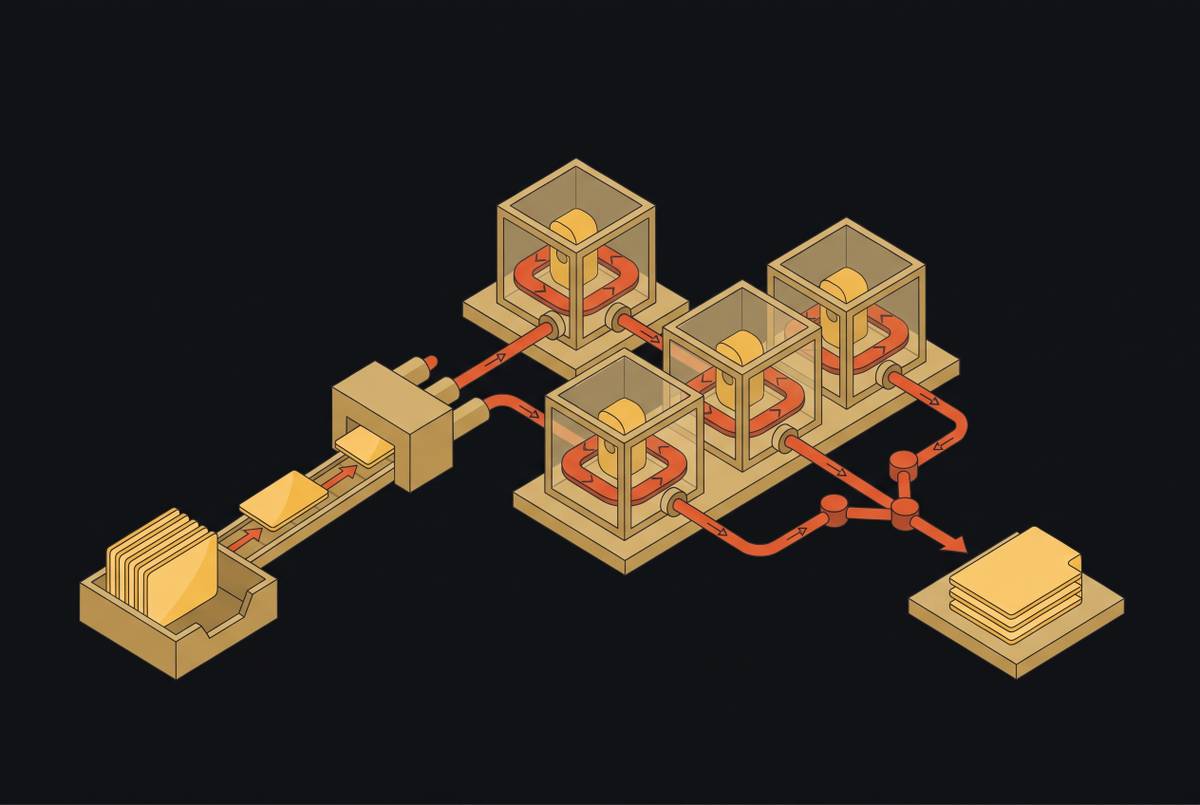
Claude Code's documentation states that “more than one task can work on the same repository at the same time,” with each task creating its own PR. Each execution has its own environment. The team does not have to reproduce its setup work manually for every additional issue.
Cursor's cloud agent implementation uses a dedicated Firecracker microVM for each agent across isolated Git worktrees and supports parallel agents. Here, isolation provides the basis for concurrent execution. It separates each task's working state instead of requiring agents to share a single mutable workspace. Simultaneous changes still need review.
OpenAI's Harness Engineering team illustrates the scale that agent-driven execution can reach. Over five months, a team that started with three engineers and grew to seven drove Codex to open and merge a large volume of pull requests. The work covered application logic, tests, CI configuration, documentation, and observability, with every line written by the agent. That example demonstrates breadth and scale while leaving the productivity percentage other teams can expect undetermined.
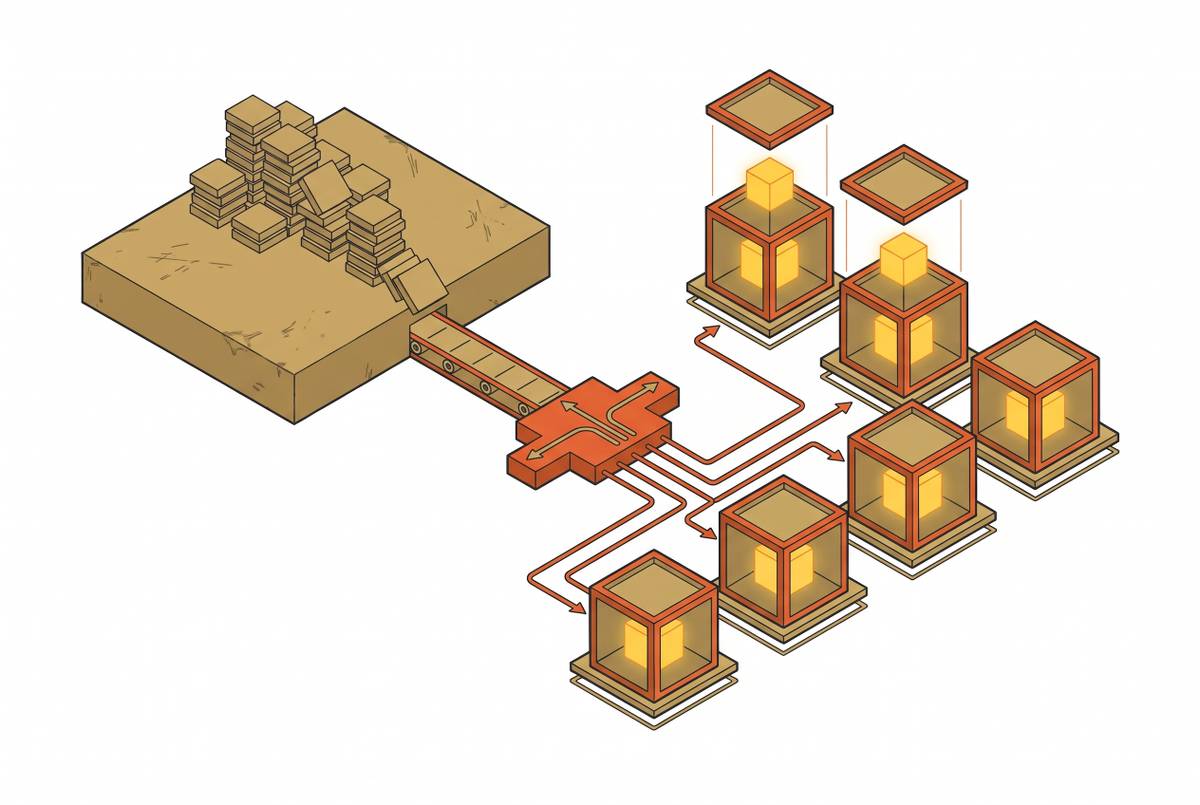
Managed execution can also separate harness choice from infrastructure choice. Teams can assign planning and complex refactoring to one harness while another handles parallel test generation or rapid code tasks, provided the environment supports that portability. The VM and repository integration need not change with the agent. Scaling from one task to eight then does not require the team to provision eight VMs, manage eight credential sets, or write eight CI configurations. The managed layer absorbs that operational work, although parallel execution still consumes compute.
Where security and governance controls must live when agents open PRs autonomously
Autonomous PR generation relocates governance from individual developer habits to infrastructure policy, but only when the environment actually provides those controls. Managed hosting alone is insufficient. The boundary to guard is between untrusted issue or PR content and an agent whose tools can read data or write code.
Microsoft's research makes that boundary concrete. An issue body is task input, but it can also contain instructions intended to redirect tool use toward secrets or external channels. More careful prompting is not a substitute for isolation. Sandboxing and secret separation must constrain what the agent can access even when its interpretation of the input goes wrong.
Secret scanning must also run on every PR that an agent opens before it is merged. Agents commit credentials more often than human developers, so scanning cannot depend on the agent remembering to invoke it. PR policy gates, audit logging, and sandbox isolation belong in the platform's governance model. For enterprise adoption, these controls must be in place before deployment.
Bedrock's data controls state that prompts and completions are not used for model training and that providers cannot access them. Zero data retention can be configured so that request and response data is not written to durable storage. Those controls address model data handling, while repository execution requires its own risk controls. Teams must check a managed platform on both sides of that boundary, while those running agents locally must build and maintain their own execution controls.
How to evaluate a managed agent platform for issue-to-PR work
For an engineering lead, the evaluation should begin with what the environment removes from the team's workload. Evaluate whether the platform supplies the integration, isolation, credential, and governance requirements without custom infrastructure work. For a bring-your-own API key requirement, model-key support and managed execution are separate acceptance criteria.
The platform should be assessed for connections to GitHub, Linear, GitLab, Slack, and webhook sources without custom glue code. A missing hand-off can restore the work that managed execution was meant to remove. Harness portability is the companion test, including whether Claude Code, Codex, Cursor, or OpenCode can run without changing the environment or workflow.
Credential handling deserves a more precise question than whether authentication is supported. Are GitHub tokens short-lived and issued through the platform's identity layer, or must a developer paste a long-lived token into an environment variable? The isolation test is similarly concrete. Each task should have its own VM rather than a shared execution environment that reintroduces credential and state-contamination risks. Support for a customer's model API key alone guarantees neither of these safeguards.
Governance and billing complete the assessment. Audit logs, PR secret scanning, and administrative access controls should come with the platform by default, with no need to add them on. A workspace-minute model that charges while the VM is active and nothing while it sleeps aligns billing with compute use, while per-seat or per-ACU models can obscure parallel-work costs.
What zero-DevOps issue-to-PR actually looks like in practice
When the managed path works correctly, the developer opens an issue and later receives a PR to review. No intervening step requires that developer to provision a VM, repair a runtime, update a secret, or write a workflow file for the next task. The absence of those interruptions is observable. It is a more useful test of the managed layer than the mere presence of an agent in the cloud.
Sentry's internal workflow illustrates the automated end of this model. A Slack channel receives notifications when the agent opens new pull requests, and a Claude routine processes the feed rather than a human reviewing every notification individually. Attention moves toward the review gate. The notification stream reports what the agent has done, with no queue of infrastructure requests for the team to handle.
Linear reports resolving roughly a third of incoming bug reports through its automated workflow, mostly on the first pass, before the issue reaches an engineer. A Sentry alert rule can create the Linear issue, after which the Sentry Agent for Linear, powered by Seer, gathers evidence, traces the root cause, and produces a fix. This is a specific reported outcome. It does not establish that every repository or class of bug will achieve the same result.
In the /ultraplan “accept on web” path, the developer approves the browser-based plan and can turn to other work while the environment handles implementation and delivery. Both routes still need a human to judge the change. If the next task requires a new DevOps action, the managed layer is incomplete. If it produces a reviewable PR without that intervention, autonomous execution has reached its proper boundary, where a human can merge, comment, or send the work back.